
The Man Who Was Not Supposed to Matter
How a Romanian nobody filed a complaint against a powerful Danish analyst -- and the entire system mobilized to destroy him instead of investigating

“When you see that trading is done, not by consent, but by compulsion -- when you see that in order to produce, you need to obtain permission from men who produce nothing -- when you see that money is flowing to those who deal, not in goods, but in favors -- you may know that your society is doomed.”
-- Atlas Shrugged
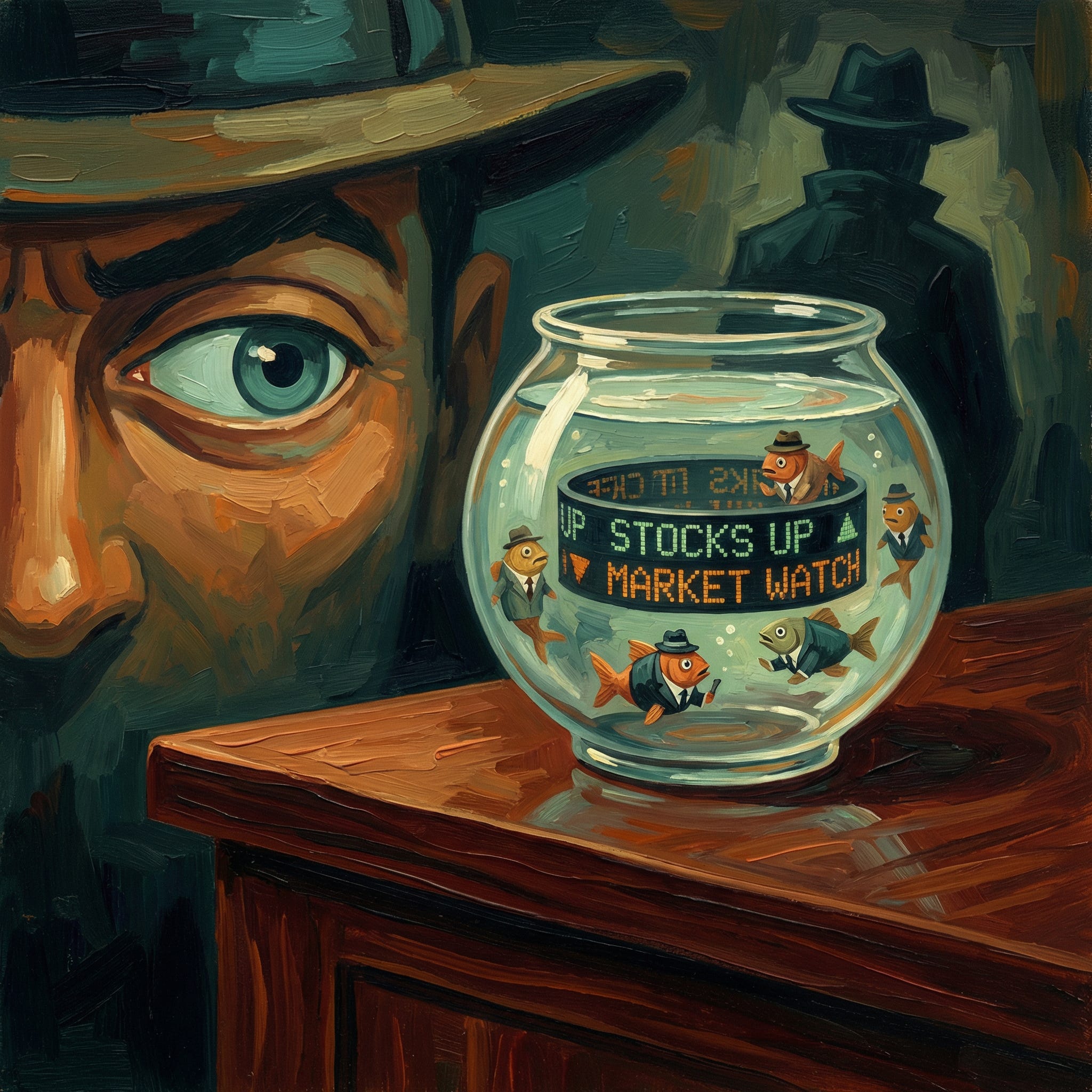
On the morning of December 5, 2025, Denmark’s financial newspaper Finans published its first article about me.
Not about my company’s record-breaking revenue. Not about our robots teaching coding to children in schools across Europe. Not about the fact that Shape Robotics had just been advanced from the junior exchange First North to the main Nasdaq Copenhagen market because growth was so strong that regulators deemed us ready for the big leagues.
The article was about me. Personally. A Romanian. With a past they had spent weeks excavating through Romanian court databases.
This is the story of what happened next -- and more importantly, what happened before. If you read nothing else this weekend, read this. Because this is not a story about one small company. This is a story about what happens in a system so small, so interconnected, and so certain of its own virtue that it cannot tolerate someone from outside its walls pointing at what is visible to anyone willing to look.
The Fishbowl

To understand anything about this story, you must first understand the stage on which it was performed.
Nasdaq Copenhagen -- the entire Danish stock exchange -- lists roughly 142 companies. The total market capitalization of every single company in Denmark, added together, is approximately EUR 523 billion. Apple, one single American company, is worth more than all of them combined. The entire Danish stock market is, in the language of global finance, a rounding error.
Now zoom in further. First North Denmark, the junior exchange where Shape Robotics was born, is so small that on any given day, many stocks trade in volumes measured not in millions, not in thousands, but in dozens of transactions. Some days, certain stocks don’t trade at all.
This matters enormously. In a market this small, editorial coverage by a major financial outlet is not a commodity -- it is a scarce and powerful resource. There are only so many journalists, only so many column inches, only so many hours in the news cycle. Every article written about a micro-cap company like Shape Robotics is an article not written about Novo Nordisk’s sixty billion euro market cap swing, or Danske Bank’s two hundred billion euro money-laundering scandal, or the dozens of other stories competing for attention in Denmark’s tiny financial ecosystem.
Editors choose what to cover. And choices, as anyone who has ever sat in a boardroom knows, reveal priorities.
So when a fishbowl this small suddenly generates a tidal wave of coverage about one tiny fish -- six articles in ten weeks, after five and a half years of absolute silence -- the interesting question is not “what is wrong with the fish?”
The interesting question is: who disturbed the water?
The Timeline That Nobody Wanted to Print
On December 12, 2022, Lars Topholm -- Managing Director at Carnegie Investment Bank and one of Denmark’s most decorated equity analysts, a man who has been named “Stock Analyst of the Year” multiple times over a career spanning more than two decades -- purchased 3,500 shares in Shape Robotics. At the closing price that day, his investment was worth approximately 100,000 Danish kroner.
Fifteen months later, in early March 2024, Topholm published what he called a “back of the envelope analysis” of Shape Robotics. The opening line of that analysis was: “Are you looking for an idea for micro cap, where there is a theoretical possibility of a three-four times higher share price over the coming years?”
The analysis modeled scenarios in which the stock could be worth DKK 46.7 or DKK 58.4 in the near term, and projected a theoretical price of DKK 131.3 by 2027 -- more than three times the trading price at the time. Coming from an analyst of Topholm’s stature, this was not a casual remark. In Denmark’s tiny market, when a man of that reputation speaks, people listen. Portfolios move.
What Topholm did not mention -- not in a single word, not in a footnote, not in a disclaimer -- was that he personally owned 3,500 shares in the company he was recommending. He had skin in the game. He had money on the table. And he told no one.
On March 18, 2024, the Shape Robotics stock price peaked at DKK 52 per share, following several days of significant gains after Topholm’s analysis circulated.
On April 24, 2024, Topholm sent an email to Shape Robotics’ chairman. He opened with the words: “I allow myself to turn as a concerned shareholder and nothing else (that is, not in any Carnegie role).” This is important language. The man who had just published a bullish analysis without disclosing his ownership was now writing privately -- explicitly flagging that he was not acting in his professional capacity -- to raise concerns about the company. Among the recipients of that email was Martin Bundgaard, who held 318,311 shares.
Two days later, on April 26, 2024, Topholm sold all his shares. The stock opened at DKK 34 that morning.
Over the following weeks, a pattern emerged that is impossible to ignore. Martin Bundgaard -- the same man who received Topholm’s private email -- sold his entire position of 318,311 shares during April and May. Soren Bendixen, another investor holding over 70,000 shares, sold his position in June.
And then something happened that transforms this from a sequence of suspicious trades into something far more architecturally coherent: Lars Topholm became chairman of Aerbio, a biotech company founded and co-owned by Martin Bundgaard and Soren Bendixen. The same two men whose shares exited Shape Robotics in coordinated fashion after Topholm’s private communications now had Topholm sitting as chairman of their company.
Buy. Promote without disclosing. Price spikes. Private communication to major shareholders. Coordinated exit. Business relationship consolidation.
This is the timeline. These are dates. These are names. These are transactions recorded on the Nasdaq exchange and documented in corporate registries. None of this is speculation. None of this is inference. This is what happened.
And for fourteen months, not a single major Danish financial outlet published a word about it.
The Expert Who Turned
On February 11, 2026, the independent outlet Frihedsbrevet finally published the Topholm story. They did what financial journalism is supposed to do: they laid out the dates, the trades, the non-disclosure, and the network connections. They interviewed Lars Krull, a senior advisor and banking expert at Aalborg University, who assessed the situation and stated plainly: “It’s very important to declare” and “one should declare that there may be a capacity issue.”
Topholm’s response, through Carnegie’s communications department, was two words: “No comment.”
Martin Bundgaard’s response: “I can 100 percent reject the allegations.”
Soren Bendixen: “I can completely reject the postulate.”
Carnegie: “No comment.”
The Danish Financial Supervisory Authority: “We cannot comment on individual cases.”
Nasdaq: “We do not wish to comment on individual companies.”
This is the sound of a system closing ranks.
But there is another detail in this story that deserves its own section, because it reveals something about how the machinery of perception works in Denmark -- and because it has now blown up in Finans’ face.
In the Finans article about my Romanian background -- the “Luksusbiler og poser med penge” piece about the Vodafone corruption case -- Finans quoted an academic named Catalin-Gabriel Stanescu, a lecturer at the Department of Law at the University of Southern Denmark and a former corporate attorney in Romania. He was presented as an expert on Romanian whistleblower law. His comments were used to frame my cooperation with Romanian anti-corruption authorities in a particular light -- suggesting that whistleblowers in Romania cooperate with prosecutors primarily to avoid their own punishment. That framing was then embedded in an article whose headline declared that I had “admitted corruption.”
There was just one problem: Stanescu’s actual academic expertise is not in criminal law or whistleblower protection. His published research -- easily verifiable on SDU’s own research portal -- is about consumer financial protection, abusive debt collection practices, and the regulation of informal creditors in the EU. His Marie Curie-funded project was about debt collection. His stated professional goal is to become “the leading expert in regulating informal debt collection practices in the European Union.” He is a consumer protection researcher who happens to be Romanian and happens to work in Denmark.
And there is a much bigger problem, because Stanescu himself has now described what actually happened.
In a private message, Stanescu recounted the following: Finans called him and asked general questions about Romanian law. He gave general answers. He asked for context -- what case, what person, what situation -- and Finans refused to provide details. They then came back with selected quotes from his general answers, paired with a fragment of the article. He edited the quotes because, in his words, they were being stretched beyond what he had said. He asked for a copy of the final published article. Finans told him they would send it after further edits. He never heard from them again.
To this day, Stanescu has not seen the published article. Finans has a paywall, the article is in Danish, and as he put it: he would not pay money to read their publication.
Let that sink in. The academic expert quoted in a front-page investigative article -- the man whose credentials lent scholarly authority to the framing of a whistleblower as a corrupt actor -- was never shown the final article. He was given no context about the case he was being asked to comment on. His answers were general observations about how Romanian law works and how it is perceived in society, untethered to any specific situation. He edited Finans’ initial quotes because they distorted what he had said. And then Finans published without sending him the final version.
In his own words, he walked into it blind -- “ca musca-n lapte,” a Romanian expression meaning he stumbled in like a fly landing in milk, completely unaware of what he was being used for.
This is not a minor procedural complaint. This is the manufacturing of expertise. Finans needed a Romanian academic to lend credibility to a particular narrative about whistleblower motivations in Romania. They found one at a Danish university. They asked him abstract questions. They withheld the context that would have allowed him to understand how his words would be deployed. They edited his quotes in ways he had to correct. And then they published without his final approval, behind a paywall he cannot read, in a language he does not work in professionally.
The casual Danish reader, encountering a quote from a University of Southern Denmark lecturer on Romanian law, would assume that an expert had reviewed the specific facts and rendered a considered opinion. That assumption is false. The expert reviewed nothing. He was given nothing to review. And he has told me, directly, that he regrets the situation.
The Letter to the Court
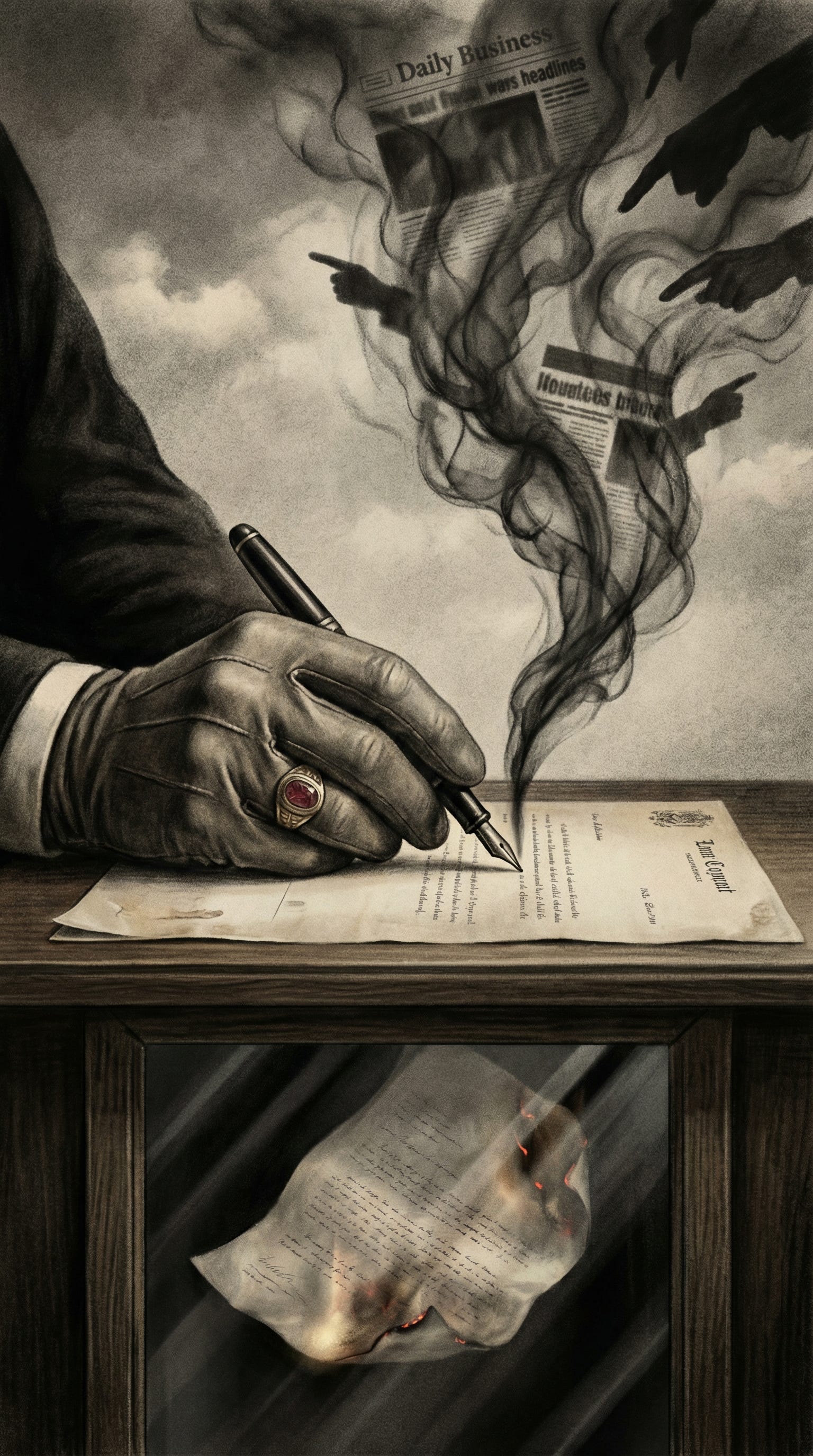
On February 3, 2026, Finans filed its formal response to my complaint before the Danish Press Council (Pressenaevnet). That document -- signed by editor-in-chief Simon Bendtsen -- is now public. And it is perhaps the most revealing document in this entire affair, not for what it argues, but for what it accidentally confesses.

The letter opens with a procedural attack. Before addressing any substance, Bendtsen asks Pressenaevnet to order me to re-file my complaint in Danish or provide a certified translation. He describes my complaint as “ret omfattende og noget ustrukturerede og uklare” -- “rather extensive and somewhat unstructured and unclear.” The message to the press council is unmistakable: this foreigner cannot even file a proper complaint in the proper language, so how seriously should you take him?
This is not journalism defending its methods. This is a gatekeeper pulling up the drawbridge. In a country that prides itself on transparency, openness, and international engagement, the editor-in-chief of Denmark’s leading financial news outlet opens his defense by arguing that a complaint in English -- the language of international business, the language in which I conducted Shape Robotics’ investor relations, the language in which Nasdaq Copenhagen publishes its own regulatory announcements -- is somehow insufficient for a media ethics proceeding.
But the truly devastating passage comes later, in the section about the corruption article. Bendtsen writes -- in a sworn submission to a regulatory body -- that the article “bygger i vidt omfang paa de oplysninger, som Mark Abraham selv har praesenteret for de rumaenske antikorruptionsmyndigheder.”
Translation: “The article is built to a large extent on the information that Mark Abraham himself presented to the Romanian anti-corruption authorities.”
Read that sentence again. The editor-in-chief of Finans has formally confirmed, to the Danish Press Council, that the corruption article is built on my whistleblower testimony. The very same article whose headline reads “Topchef i Shape Robotics har indrommet korruption” -- “CEO of Shape Robotics has admitted corruption” -- is, by the editor’s own admission, based on material I provided to Romanian prosecutors as a cooperating witness reporting illegal conduct by others.
In the history of Danish journalism, has a whistleblower’s testimony ever been repackaged as evidence of the whistleblower’s own guilt, and has the editor ever confirmed this repackaging in a formal regulatory filing? I do not know. But I suspect the answer is no.
The EU Whistleblower Directive (2019/1937), which Denmark was required to transpose into national law by December 2021, exists for precisely this reason. Article 19 explicitly prohibits retaliation against whistleblowers, including reputational damage. The directive was created because legislators understood that if people who report corruption can have their testimony turned into weapons against them, no one will ever report corruption again.
And in his Pressenaevnet letter, Bendtsen also makes a claim that is directly contradicted by documented evidence in my possession: he states that Finans never published an article without my comments, “medmindre han har afvist at kommentere” -- unless I refused to comment. He claims I was always given sufficient time to respond.
The WhatsApp Method
Let me show you what “sufficient time to respond” looks like in practice.
On the morning of February 12, 2026, a Finans journalist sent me a WhatsApp message. It read: “Hi Mark. The administrator says that 4,5 mio euro were stolen, and that the theft was orchestrated by the management. Were you part of this, and what is your reaction?”
That was the question. No context. No documents attached. No identification of which administrator, which company, which jurisdiction, which legal proceeding. Just: “4.5 million euros were stolen. Were you part of this?”
When I asked “Administrator of?” the journalist replied: “Sanako.”
I responded that the question made no sense without context, that all board activities at Sanako were conducted in perfect conditions, and that the CEO of Sanako was Andre Fehrn. I asked: “What context do you need?”
The journalist’s reply: “The context of the question. If u ask me weather we did credit fraud. I have already replied that. Last time.”
I said: “Absolutely not. And to say that money were stolen by Shape from Sanako is absurd.”
This exchange -- which I have preserved in its entirety -- encapsulates Finans’ method. It is not an interview. It is not journalism. It is the construction of a quote. You send a loaded, context-free question via text message. If the subject answers defensively -- as any human being would when ambushed with an accusation of theft -- you have your quote. If the subject refuses to answer, you write “Mark Abraham declined to comment,” which reads as guilt. If the subject asks for context or documents, you can write that they were “evasive” or “unwilling to engage with the allegations.”
There is no scenario in which the subject wins. The question is designed to produce a publishable reaction, not to elicit truth.
And this is the method Finans’ editor-in-chief describes to Pressenaevnet as “sufficient opportunity to respond.” This is what he calls “fornoeden forelaegning” -- adequate presentation of the case.
The Day After
Here is a fact that anyone can verify.
On February 11, 2026 -- a Tuesday -- Frihedsbrevet published its investigation into Lars Topholm’s undisclosed shareholding, his bullish analysis, the price spike, the coordinated exits, and the subsequent business relationship with the network of sellers. An independent banking expert went on record calling the non-disclosure problematic. Carnegie refused to comment. The story was thorough, documented, and damning.
On February 12, 2026 -- one day later, a Wednesday -- Finans published a new escalation: the Finnish subsidiary’s bankruptcy curator had allegedly stated that 4.5 million euros had been “stolen” by “the company’s management.”
Inside the same Finans article, however, the following facts are also reported: the Finnish curator was appointed after a February 5 bankruptcy, meaning he had been on the case for exactly one week. He refused to name which individuals he was referring to. He stated that his investigation was “still very early.” The allegedly stolen funds relate to a EUR 4 million loan from Alisa Bank and Veritas, 80% guaranteed by the Finnish state agency Finnvera, and publicly disclosed via a Nasdaq stock exchange announcement on November 28, 2025. All three financial institutions declined to comment.
And critically: Finans did not publish the curator’s actual written statement. No document. No date. No addressee. No legal context. A single week’s worth of preliminary impressions from a newly appointed administrator was packaged as a headline containing the word “theft” -- and published precisely one day after an independent outlet exposed the conduct of one of Denmark’s most powerful analysts.
This is either the most remarkable editorial coincidence in Danish journalism history, or it is exactly what it looks like.
The Network Nobody Maps
Let me now introduce you to Martin Bundgaard, because understanding who he is transforms this story from a financial dispute into something far more structural.
Martin Bundgaard is not a passive retail investor who happened to buy and sell shares. According to Danish corporate records and publicly available biographical information, Bundgaard spent decades as a stockbroker and journalist at Penge & Privatoekonomi and Boersens Nyhedsmagasin -- the magazine division of Dagbladet Boersen.
Boersen is 49.9% owned by JP/Politikens Hus.
JP/Politikens Hus owns Finans.
The man who held 318,311 shares in Shape Robotics, who received Lars Topholm’s private email about concerns in the company, who sold his entire position in the weeks following that email, and who co-founded the company where Topholm subsequently became chairman -- that man spent his career inside the same media group that is now publishing escalating coverage against me.
Through his holding company SUNDVAENGET INVEST ApS, Bundgaard has been commercially active in Denmark since 1978. Nearly half a century of relationships in the Danish financial and media ecosystem.
I am not suggesting that Bundgaard personally called Finans and ordered the articles. I do not know that, and I will not claim what I cannot prove. What I am stating is that the network exists. The connections are documented. The overlap between the analyst, the shareholders, the media group, and the business relationships that crystallized after the coordinated share exits is a matter of public record. And not a single major Danish financial outlet has mapped it.
What the Rest of the World Does About This
In April 2003, the United States Securities and Exchange Commission announced the Global Analyst Research Settlement -- a $1.4 billion enforcement action against ten of the largest investment banks in America. The fundamental charge was straightforward: analysts had published biased research while hiding personal and institutional conflicts of interest. Two individuals -- Henry Blodget of Merrill Lynch and Jack Grubman of Salomon Smith Barney -- were permanently barred from the securities industry and paid millions in personal fines. Their crime was publishing bullish recommendations while privately holding contemptuous views of the stocks they were promoting. The settlement fundamentally restructured how investment banks manage the relationship between research and banking.
In the aftermath, the SEC created Regulation AC -- Analyst Certification -- which requires every research analyst in the United States to certify that their published views genuinely reflect their beliefs, that any compensation linked to their recommendations is disclosed, and that personal financial interests in the securities they cover are transparent.
In 2017, the SEC charged 27 individuals and entities for publishing bullish stock articles without disclosing they had been compensated. Over 250 articles contained false statements claiming the authors were not paid. The SEC’s Acting Director of Enforcement stated: “If a company pays someone to publish or publicize articles about its stock, it must be disclosed to the investing public.”
In December 2022, the SEC charged eight social media influencers in a $100 million stock manipulation scheme. The pattern was the same: buy a stock, promote it to followers without disclosing ownership, then sell after the price rises. Collectively, these influencers had over 1.5 million followers.
The principle the SEC has enforced -- repeatedly, expensively, and without exception -- is simple: if you recommend a stock and you own it, you must say so. If you don’t say so, you have committed fraud. The size of your position is irrelevant. The platform you use is irrelevant. Whether you call it an “analysis” or a “back of the envelope” thought or a tweet or a Discord message is irrelevant. The disclosure obligation is absolute.
Denmark, as an EU member state, is subject to the EU Market Abuse Regulation, which has been in force since July 2016. Under MAR Article 20 and its implementing technical standards, anyone making an investment recommendation must disclose their holding history and any positions exceeding 0.5%. Denmark’s own industry body, Capital Market Denmark, published recommendations stating explicitly that as a general rule, analysts may not hold financial instruments issued by companies they cover, and where they do, they must disclose this and are not allowed to trade against their own recommendations.
Lars Topholm held shares. Lars Topholm published a recommendation. Lars Topholm did not disclose. The stock price rose. Lars Topholm sold.
The Coverage Asymmetry
For five and a half years -- from Shape Robotics’ IPO in June 2020 to November 2025 -- Finans published zero articles about the company. During this period, the company grew revenue from near-zero to DKK 302 million. It was selected as a “growth comet.” It was advanced to the Nasdaq main market. The Danish state fund EIFO invested public money. None of this generated a single line of coverage.
Then, in late November 2025, I filed a formal complaint with Nasdaq Copenhagen against Lars Topholm, alleging market manipulation and undisclosed conflicts of interest.
In the ten weeks that followed -- December 2025 through mid-February 2026 -- Finans published at least six major articles about Shape Robotics and me personally. Romanian fraud charges. Romanian corruption. Finnish “theft.” Unpaid bills. Bankruptcy.
And in all that time -- across all those articles, all those column inches, all those editorial resources deployed -- Finans published precisely zero words about the Topholm timeline.
Not the undisclosed shareholding. Not the bullish analysis. Not the price spike. Not the coordinated exits. Not the Aerbio chairmanship. Not the Bundgaard network. Not a single word.
It took Frihedsbrevet -- an independent outlet, smaller, newer, less resourced -- to do what Denmark’s most powerful financial newsroom would not.
What I Am Actually Asking For

“I swear by my life and my love of it that I will never live for the sake of another man, nor ask another man to live for mine.”
That oath, from my favorite book, is not about selfishness. It is about the refusal to accept that your life and your reputation should be someone else’s currency. It is the belief that truth is not a negotiation and that the marketplace of ideas only functions when the participants are honest about their positions.
I am not asking anyone to believe me because I say so. I am asking for the standard that any system calling itself a free market should demand.
First, publish the documents. If Finans possesses a Finnish curator statement that uses the word “theft,” publish the document. Let the metadata speak. Let the context be visible. Let every reader form their own judgment from source material, not from a journalist’s interpretation of a one-week-old preliminary impression.
Second, cover the documented timeline. The Topholm sequence -- purchase, promotion, non-disclosure, price spike, private communication, coordinated exit, business consolidation -- is not an allegation. It is a series of dates and transactions. It can be confirmed or denied by Nasdaq records, corporate filings, and Carnegie’s compliance department. Investigate it. Print what you find. If Topholm did nothing wrong, the records will show that.
Third, disclose the connections. Martin Bundgaard’s decades at Boersen and in the stockbroking community. His holding company. His co-founding of Aerbio. Topholm’s chairmanship. Bendixen’s positions. The network is in the public record. Map it. Show it. Let readers decide if it matters.
Fourth, interrogate the expert. Finans presented Catalin-Gabriel Stanescu as an authority on Romanian whistleblower law. His actual published research is about consumer debt collection regulation. Ask him -- on the record -- whether he considers himself an expert on Romanian criminal immunity deals. And if he does not, ask Finans why they presented him as one.
The Only Question
“The question isn’t who is going to let me; it’s who is going to stop me.”
I built a company from nothing. A Romanian immigrant with no Danish connections, no old-boys network, no membership in the circles where editors and analysts and shareholders drink wine at the same tables. We took a robot from a university lab and put it in classrooms across Europe. Revenue went from zero to three hundred million kroner. We were selected among the top 30 global EdTech companies by TIME magazine and Statista.
And none of that made me visible.
I became visible the moment I filed a complaint against a man who sits at the center of the network.
The system’s response was not to investigate the complaint. The system’s response was to investigate the complainant. Every piece of my past that could be excavated was excavated. Every ambiguous legal situation in a foreign jurisdiction was presented in the worst possible light. A whistleblower’s testimony was repackaged as a confession. An academic whose expertise is in debt collection was presented as an authority on criminal law. And the man at the center of the documented timeline -- the analyst who bought, promoted, didn’t disclose, and sold -- was given the courtesy of “no comment.”
“Something is rotten in the state of Denmark.”
Shakespeare wrote that line for a play about a prince who discovered that the people running the kingdom had committed a crime -- and that the court’s response was not justice, but silence. Hamlet spent five acts agonizing over what to do with the truth.
I am not Hamlet.
I filed the complaint. I published the evidence. I am writing this for you -- every shareholder who trusted the market, every citizen who pays for the institutions that are supposed to keep it fair, every journalist who entered the profession because they believed it existed to hold power accountable rather than to protect it.
Read the Frihedsbrevet investigation. Read Finans’ coverage. Look at the timeline. Look at the network. Look at the dates.
And then ask the only question that matters:
Who is being protected -- and who is being destroyed?
The Frihedsbrevet investigation, published February 11, 2026:
https://frihedsbrevet.dk/skandaliseret-topchef-i-konkursramt-selskab-langer-ud-efter-finansguru/
Finans’ formal response to Pressenaevnet, filed February 3, 2026: referenced throughout this article.
Shape Robotics’ Nasdaq complaint against Lars Topholm: filed November 2025.
Subscribe. This story is not over.