
ȚEAPA DANEZĂ
How a Western Legal System Declared a 170-Million-RON Business Worth Zero — and Why Franz Kafka Would Have Recognized Every Page of the File

“Someone must have slandered Josef K., for one morning, without having done anything truly wrong, he was arrested.”
— Franz Kafka, The Trial

Go to www.ar-studio.net.
The page says: Site is Under Construction. A phone number. An email. A logo. Nothing else.
AR-Studio was a concept developed by StoryKids S.R.L., a Romanian education company. It was the prototype for what later became the SmartLab — a turnkey classroom solution combining robotics hardware, curriculum software and teacher training. The concept proved that Danish-designed Fable robots could be integrated into Romania’s national education framework. When Shape Robotics A/S acquired StoryKids in August 2021, it acquired AR-Studio with it. The concept became the SmartLab. The SmartLab became the product. The product became 63% of Romania’s STEAM education market.
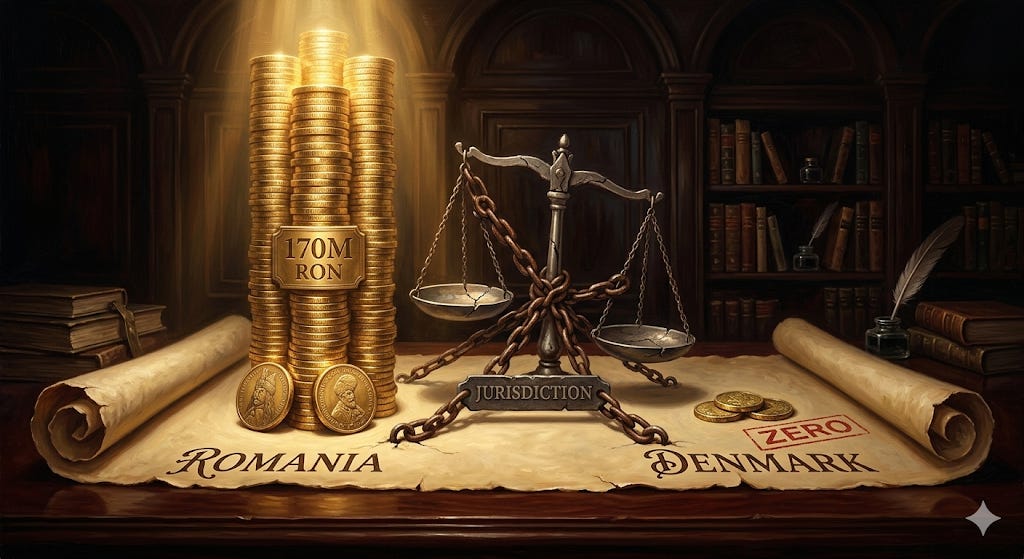
That market generated 170 million RON in revenue and 26.2 million RON in profit in 2024 through Shape Robotics Romania S.R.L., the subsidiary that executed what AR-Studio had designed.
On January 6, 2026, a Danish court declared Shape Robotics A/S bankrupt. A trustee from Kromann Reumert was appointed. He assessed the estate and informed the court: there are no assets.
This article examines how that conclusion was reached, what it means for creditors, and why Denmark’s opt-out from EU judicial cooperation created the structural conditions for it.
The Word
In Romanian, “teapa” is a stake. The historical reference is to Vlad Tepes, the 15th-century ruler known in the West as Dracula, who used impalement as a form of public punishment for corruption and theft. The word survived in modern Romanian as slang. “Mi-a tras o teapa” means: someone followed the rules on paper while extracting all the value from the other side. It describes a mechanism, not an emotion — a transaction where the letter of the agreement is honoured and the spirit is gutted.
The term applies here because the facts support it.
The Corporate Structure
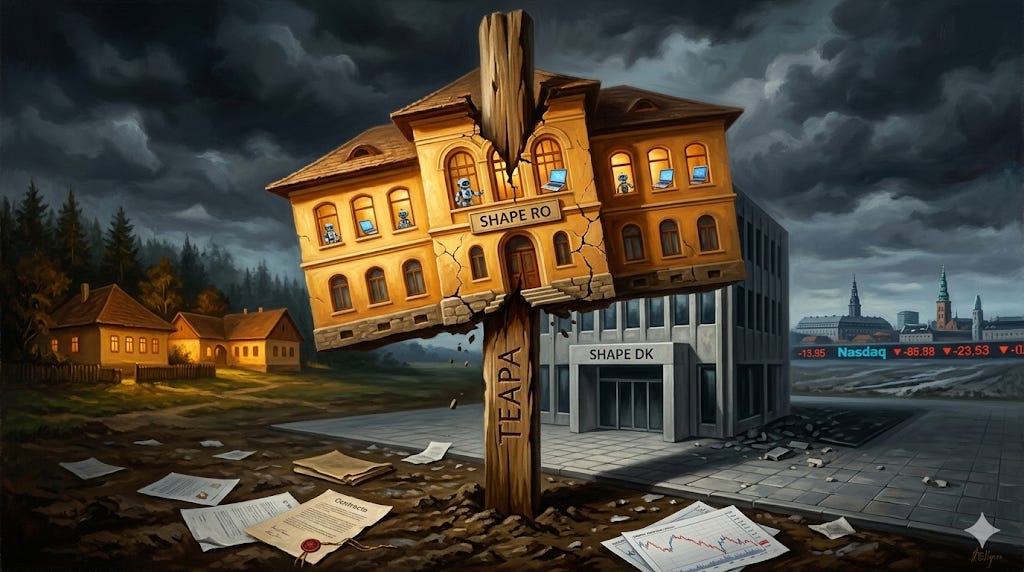
Shape Robotics A/S was registered in Herlev, Denmark. CVR number, Nasdaq Copenhagen listing, Danish board. On paper, a Danish company.
In practice, approximately 95% of the group’s revenue originated in Romania. The operating subsidiary, Shape Robotics Romania S.R.L., ran the contracts, employed the staff, maintained the SmartLabs and held the relationships with county school inspectors, PNRR administrators and the Romanian Ministry of Education.
The parent company’s principal function was to hold the listing, manage investor relations and consolidate the financials.
The Numbers
Shape Robotics Romania S.R.L.:
2020: Revenue 1.7 million RON. Profit 144,972 RON.
2024: Revenue 170 million RON. Profit 26,220,062 RON.
Group level (Shape Robotics A/S consolidated):
2022: Revenue 39 million DKK.
2023: Revenue 171 million DKK.
2024: Revenue 302 million DKK.
The growth was driven by SmartLab deployments in Romanian schools, funded primarily through the EU Recovery and Resilience Plan (PNRR). The hardware was manufactured by Moby Industries. The curriculum integration, teacher training and market development were executed by the Romanian team.
The Acquisition
StoryKids became Shape Robotics’ exclusive distributor in Romania in 2019. In August 2021, Shape Robotics A/S acquired StoryKids. The deal included base consideration, deferred consideration contingent on performance, and consultancy and commission agreements linked to generated revenue. These terms were disclosed in the Nasdaq listing prospectus, Shape’s annual reports and investor presentations.
The Listing
Shape Robotics A/S listed on Nasdaq Copenhagen in December 2021. The investment thesis centred on the Romanian market: Romanian revenue, Romanian contracts, Romanian growth trajectory. EIFO, the Danish state investment fund, invested. Danish retail investors purchased shares. At every stage, the value proposition presented to the market was the value being created in Romania.
The Collapse
In late 2025, Finans.dk published a series of articles questioning Shape’s accounting practices. The share price fell sharply. Trading was suspended. On January 6, 2026, a Danish court declared Shape Robotics A/S bankrupt and appointed a trustee from Kromann Reumert.
The Trustee’s Assessment
The trustee’s mandate is to identify assets, assess claims and distribute value to creditors. Here is what the estate contains:
In Denmark: a CVR number, a former office lease in Herlev, no revenue-generating operations, no staff, no contracts, no receivables, no inventory.
In Romania: a 100%-owned subsidiary with 170 million RON in revenue, 26 million RON in profit, active government contracts, EU-backed projects, installed SmartLabs in schools across the country, a trained workforce and a brand holding 63% of the Romanian STEAM education market.
The trustee’s conclusion: no assets to distribute.
On that basis, the Danish court declined to appoint a creditor committee. Without assets, there is no distribution. Without distribution, creditors have no voting rights and no formal voice in the proceedings.
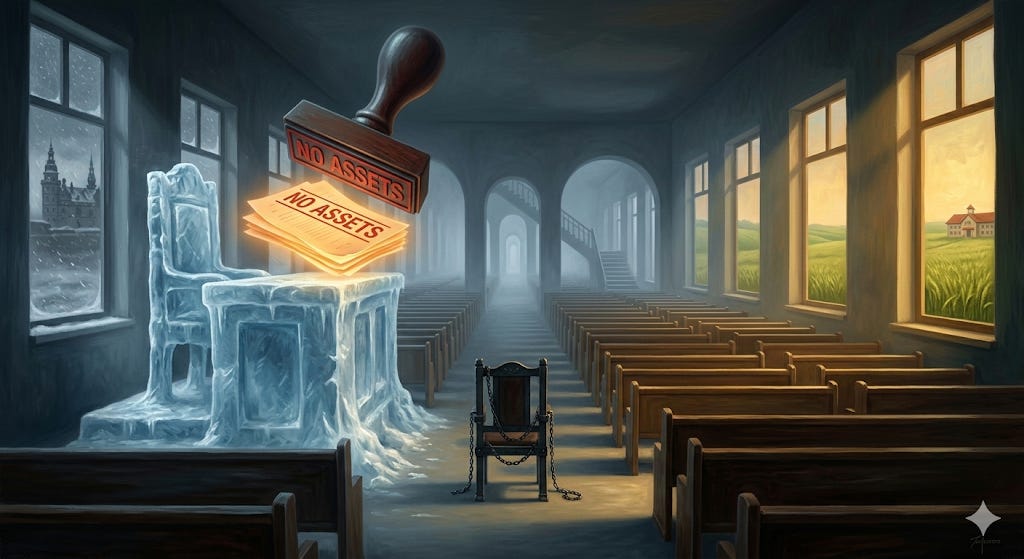
The question this raises is straightforward: how can a company that owns 100% of a subsidiary generating 170 million RON in revenue have no assets?
The Jurisdictional Wall
The answer lies in jurisdiction. Denmark opted out of the EU’s judicial cooperation framework by political choice, reaffirmed by referendum and maintained by successive governments.
The Recast Insolvency Regulation (2015/848), which enables EU member states to recognise each other’s insolvency proceedings, does not apply to Denmark. Denmark has not adopted the UNCITRAL Model Law on Cross-Border Insolvency. The only cross-border insolvency instrument Denmark participates in is the Nordic Bankruptcy Convention, covering Sweden, Norway, Finland and Iceland. Not Romania.
This creates a structural asymmetry. Romania is fully inside the EU insolvency framework. Denmark is not. A Danish trustee sitting in Copenhagen has no automatic authority over Romanian assets, and Romanian creditors have no automatic standing in Danish proceedings.
The practical effect: the trustee can declare the Romanian subsidiary is not an asset of the Danish estate, and there is no cross-border mechanism that automatically compels a different assessment.
What Was Not Done
No independent investigation into the Romanian operations was conducted. No forensic audit of the subsidiary was commissioned. No attempt was made to value the installed base of SmartLabs, the active government contracts, the brand equity, the trained workforce or the 63% market share. No creditor committee was appointed to oversee the process.
The consultancy fees, deferred consideration from the acquisition and commission agreements — all contractually tied to revenue generated by the Romanian operations — remain unpaid. The trustee’s position is that these obligations belong to an estate with no assets.
The Structural Pattern
The Shape Robotics case illustrates a replicable pattern. A Western holding company acquires an Eastern European operating company. The Western entity lists on a Western exchange using the Eastern revenue as its investment thesis. Western capital is raised. When the structure fails, the Western insolvency regime applies, and the Eastern partners and creditors find themselves outside a jurisdictional boundary they cannot cross.
Value flows West. Losses remain East. The jurisdictional wall ensures the asymmetry.
This is not a conspiracy. It is the predictable outcome of corporate structure meeting jurisdictional arbitrage within the EU’s incomplete insolvency harmonisation — specifically, Denmark’s opt-out.
Actions Taken
Claims have been filed in the Danish bankruptcy proceeding. Romanian legal counsel has been engaged. The European Commission’s Directorate-General for Justice has been notified regarding the impact of Denmark’s opt-out on cross-border creditor rights. EIFO has been asked to explain why it invested in a company whose entire value proposition rested on a subsidiary that the insolvency estate now considers worthless.
The full timeline has been shared with Finans.dk, Børsen and journalists covering this case.
Open Questions
For creditors: your claims are being administered by a system that does not recognise the value that generated them.
For Danish investors: how was a company with no meaningful Danish operations listed and promoted as a Danish growth story?
For Romanian officials: why are Danish insolvency proceedings determining the fate of Romanian assets built with Romanian public money and EU funds?
For journalists: how can a 100%-owned subsidiary generating 170 million RON in revenue be declared worth zero?
— Mark Abraham, Bucharest, February 2026
Malaka what u say now :))
See my boy? GAME OVER!