
How Danish Incompetence Destroyed a Romanian Educational Technology Success Story — And What It Means for Europe
An Investigation and Official Complaint By Mark Abraham January 10, 2026

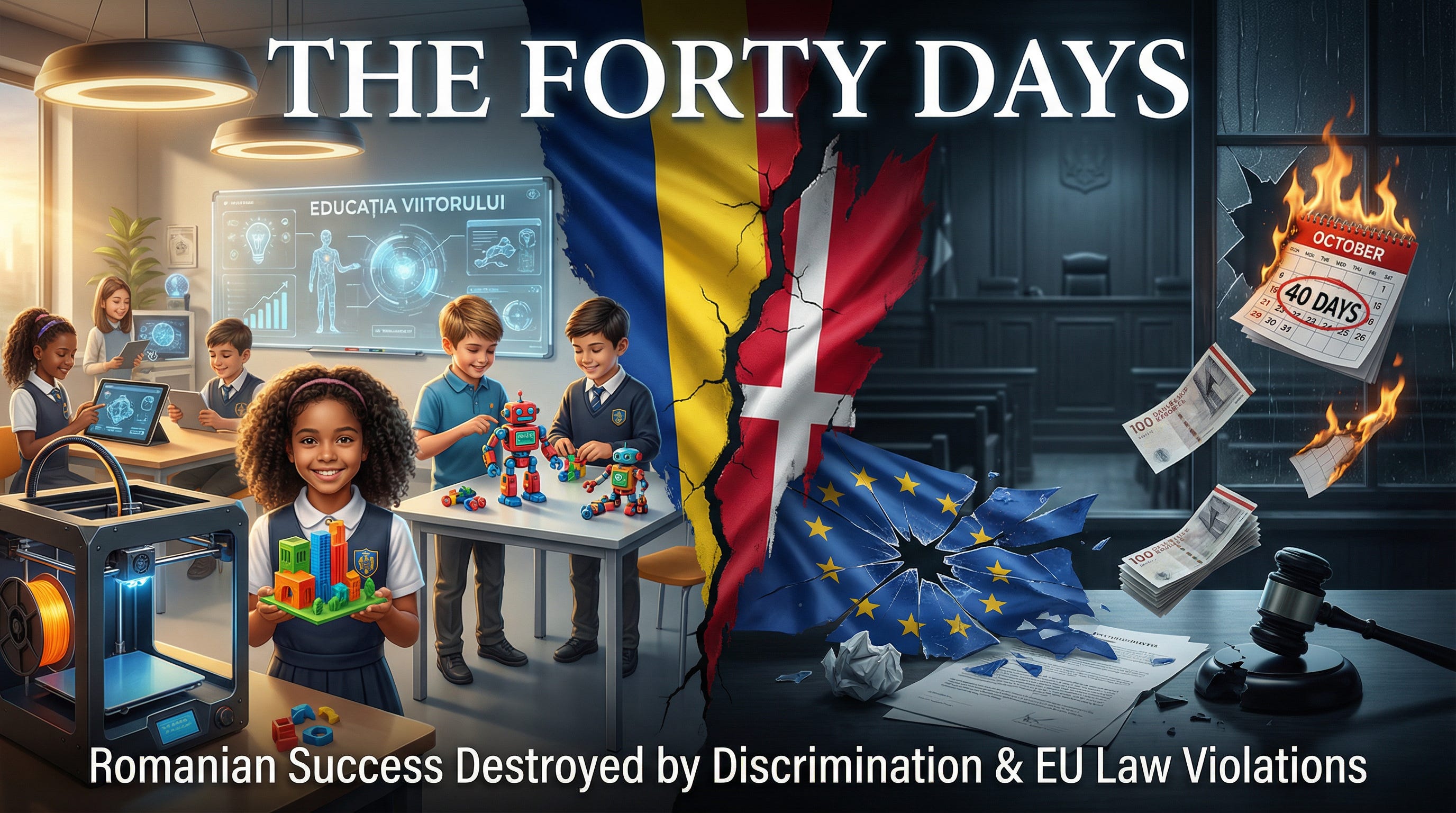
On the evening of January 6, 2026, I was working from my home office in Romania when my phone started buzzing with messages from shareholders. “What’s happening?” they asked. “Why are the shares suspended?” “Is it true?”
I had no idea what they were talking about.
It took me twenty minutes to discover that a Danish court had declared Shape Robotics A/S bankrupt that afternoon. The company my domestic partner Elena Pasat and I had built together into a 300-million-kroner success story. The company that provided educational technology to thousands of Romanian children. The company whose bankruptcy I learned about the same way as everyone else: from panicked messages and news alerts.
The Danish court had held a hearing without me. Without my knowledge. Without sending me any notification.
I am a Romanian citizen, residing in Romania. Under European Union law, specifically Regulation 1393/2007, Danish courts are required to properly serve foreign citizens in cross-border legal proceedings. They must transmit documents through official channels. They must ensure the recipient actually receives them. They must provide an opportunity to defend.
None of that happened.
But the violation of EU law was just the final act. The real story started forty days earlier, on November 27, 2025, when I filed a formal complaint with Nasdaq Copenhagen alleging market manipulation by a prominent Danish financial analyst.
What happened in those forty days is a story about whistleblowing and retaliation. About ethnic discrimination in European media. About a Romanian success story deliberately destroyed. And about whether European institutions will defend their own laws and values when the victim is Romanian.
This is that story, told in full, with complete documentation, for the Romanian government, the European Commission, and anyone who cares about justice.
PART ONE: THE ROMANIAN SUCCESS THAT NOBODY WANTED TO TALK ABOUT
The story actually begins in 2017, in Romania, with a partnership between me and my domestic partner Elena Pasat.
Elena had spent years working in educational journalism and pedagogy. She understood Romanian schools intimately. She understood teachers, curriculum development, and the humanistic side of education. She understood the gap between the education system Romania had and the education system Romanian children deserved. I brought the technology expertise—systems architecture, product development, technical implementation.
In 2017, we founded a company called StoryKids together. Elena owned the company and focused on the educational content and pedagogical approach. I served as CTO, handling all technical aspects. Our mission was straightforward: bring modern digital learning tools to Romanian classrooms.
The product was called a “smart lab” or “smart classroom.” Not just a single device, but a complete learning environment. 3D printers so students could design and build physical objects. Robotics kits for programming education. Tablets and computers for digital literacy. An integrated online platform with video-based lessons aligned to the Romanian curriculum, developed with Elena’s educational expertise. Everything a school needed to step into 21st-century education, delivered as a package, installed and ready to use.
It was exactly what Romanian schools needed, but for the first few years, scaling was slow. Government procurement is complicated. School budgets are limited. Building a business in educational technology in Romania meant patience and persistence.
Then COVID-19 changed everything.
In 2020, as Europe locked down and economies collapsed, the European Union created the Recovery and Resilience Facility—a 723-billion-euro program to help member states recover and modernize. Each country developed a plan for how to use the funds. Romania’s plan included a major focus on digitalizing education, particularly in rural and underserved areas.
Smart classrooms became a national priority, with hundreds of millions of lei allocated for procurement over several years.
StoryKids was perfectly positioned. Elena and I had the products, the experience, the relationships with the Ministry of Education, and the operational capacity to deliver at scale. In 2021, StoryKids started winning major contracts under the RRF program.
That same year, a Danish company came calling.
Shape Robotics A/S was a small firm listed on the Nasdaq Copenhagen First North exchange. It had been founded by researchers at Denmark’s Technical University who developed an educational robot called “Fable”—modular blocks that students could assemble and program. It was clever technology, but the business was modest. In 2019, Shape Robotics had revenue of 8.1 million Danish kroner—about one million euros.
When Shape Robotics executives heard about StoryKids’ success winning Romanian government contracts, they saw an opportunity. StoryKids needed capital to scale. Shape Robotics needed growth to justify a move to the main stock exchange. The combination made strategic sense.
In 2021, Shape Robotics acquired StoryKids for up to two million euros, paid partly in cash and partly in shares. Elena and I stayed on to run the Romanian operations, maintaining our division of labor—Elena handling educational strategy and content, me handling technology and operations. The plan was simple: StoryKids would continue executing its Romanian contracts while Shape Robotics provided capital, international credibility, and a platform for expansion.
What happened next exceeded everyone’s expectations.
The numbers tell the story. In 2021, Shape Robotics’ revenue was around 40 million kroner. In 2022, it jumped to 87 million. In 2023, it reached 171 million. By 2025, we were on track for over 300 million kroner in annual revenue.
Where was that growth coming from? Romania. According to the company’s annual reports, 95 percent of Shape Robotics revenue came from Romanian contracts. Not Danish robot sales. Not international expansion. Romanian smart classrooms for Romanian schools, funded by EU recovery programs, executed by a Romanian team that Elena and I had built together.
The Finans newspaper article published on January 9, 2026—the same article that framed our bankruptcy as inevitable failure—acknowledged this plainly: “It was the so-called smart classrooms that drove sales, and 95 percent of revenue came from Romania according to the annual report.”
By any reasonable calculation, StoryKids represented 99 percent of Shape Robotics’ enterprise value by 2025. The “Danish robotics company” was actually a Romanian educational technology company with a Danish stock ticker.
Thousands of Romanian students were using StoryKids smart classrooms. Rural schools in counties that had never had modern technology were getting 3D printers and robotics labs. Teachers were being trained in digital pedagogy using Elena’s curriculum materials. The online learning platform was delivering content to students across the country.
This was Romanian innovation, Romanian execution, Romanian excellence. Serving Romanian children. Funded by European investment in Romania’s future.
It was, in other words, exactly the kind of success story the European Union was designed to enable.
Nobody in Denmark wanted to talk about that part.
PART TWO: THE ANALYST WHO FORGOT TO MENTION HE OWNED THE STOCK
In March 2024, a prominent Danish financial analyst named Lars Topholm published a research report on Shape Robotics.
Lars Topholm is well-known in Copenhagen’s small financial community. He writes for several publications, appears in media, and is considered an authority on small-cap stocks. When Topholm publishes analysis, people pay attention.
His March 2024 report on Shape Robotics was glowing. He highlighted the company’s growth trajectory. He emphasized the enormous market opportunity in educational technology. He projected continued revenue acceleration. The analysis was detailed, professional, and strongly positive.
There was just one problem.
At the time he published the report, Lars Topholm personally owned shares in Shape Robotics. And he didn’t disclose that fact to readers.
In financial journalism, this is called a conflict of interest. In securities regulation, it’s a violation of disclosure requirements. In plain English, it’s something you’re not allowed to do. When you recommend a stock to others, you have to tell them if you’ll profit from them buying it based on your recommendation.
Topholm didn’t tell them.
What happened next followed a pattern that anyone familiar with pump-and-dump schemes would recognize. After Topholm’s positive analysis was published and the stock price rose on buying interest, Topholm and his business partner sold their shares. And over the following months, as I investigated trading patterns in my capacity as CEO, the evidence suggested that Topholm and his associate were working together to drive the price down through coordinated selling and negative commentary.
The pattern was clear enough: buy shares, publish positive analysis without disclosing your position, sell into the buying interest, then manipulate the price downward through coordinated trading. Classic manipulation.
As CEO of a listed company, I had a legal obligation to report suspected market manipulation to authorities. This wasn’t optional. This wasn’t a vendetta. This was my fiduciary duty to shareholders and regulatory duty under Danish securities law.
On November 27, 2025, Shape Robotics filed a formal complaint with Nasdaq Copenhagen, the stock exchange where we were listed. The complaint detailed Topholm’s undisclosed conflict of interest, provided evidence of the coordinated trading pattern, and requested a regulatory investigation.
The announcement went public that morning. “Notification of Potential Share Price Manipulation Submitted to Nasdaq,” the company announcement read. It named no names publicly—regulatory complaints are confidential—but in Copenhagen’s small financial community, everyone knew who we were talking about.
I was acting as a whistleblower, exposing financial crime through the proper regulatory channels.
What I didn’t fully understand was that I had just threatened powerful people in the Danish financial establishment. People who had the means to destroy me. People who would not tolerate a Romanian CEO exposing their schemes.
The retaliation began within twenty-four hours.
PART THREE: THE FIGHT WITH EIFO THAT BECAME A WEAPON
The next morning, November 28, 2025, Shape Robotics was forced to issue a public announcement that would change everything.
Denmark’s export credit agency, known as EIFO, was withdrawing its guarantee for part of our debt. The announcement hit the market like a bomb. Share price dropped. Investors panicked. Media started writing about “crisis” and “troubled company.”
But the real story of what happened with EIFO is more complicated than anyone reported, and it reveals something important about how we were set up to fail.
Let me explain what actually happened.
When Shape Robotics moved from the junior First North exchange to the main Nasdaq Copenhagen market in November 2023, EIFO informed us that under their standard rules, they don’t provide guarantees for companies listed on the main exchange. The logic is that main market companies supposedly have better access to capital markets and don’t need state support.
We were given time to find alternative financing. We had multiple options and were actively pursuing them throughout 2024 and into 2025. By late 2025, we had made significant progress with IRIS Capital Investment, a Paris-based institutional investor, and had signed engagement letters and term sheets. The board had given us until November to secure the alternative financing, and we were on track.
But here’s what almost nobody knows, and what makes this whole situation even more damaging: there was a way for EIFO to continue supporting us.
Under the EU’s General Block Exemption Regulation—GBER—there are specific exceptions that allow state agencies like EIFO to support companies engaged in digital transformation initiatives. This is exactly what we do. StoryKids wasn’t just selling hardware to schools. We were implementing comprehensive digital transformation of Romanian education infrastructure. Digital learning labs. Teacher training in digital pedagogy. Online platforms integrated with national curriculum. This is precisely the kind of digital transformation initiative that GBER exceptions are designed to support.
EIFO was unwilling to apply for this exception on our behalf.
Think about what this means. We had a legitimate basis under EU regulations for continued state support. We were doing exactly the kind of work—digital transformation in education—that European policy is designed to encourage. But EIFO wouldn’t even try to use the available exception.
We pushed back. Hard. We argued that they should at minimum apply for the GBER digital transformation exception before simply walking away. Eventually, after considerable pressure, EIFO did agree to explore the exception process rather than outright canceling their guarantees.
But by then, the damage was done. The November 28 announcement that EIFO was withdrawing support—even though we were actively fighting to preserve it through the GBER exception—created the crisis narrative. Investors didn’t hear “EIFO exploring exception process for digital transformation company.” They heard “EIFO pulling out, company in crisis.”
The fact that EIFO was initially unwilling to even try for an exception we clearly qualified for raises uncomfortable questions. Were they under pressure? Did someone want us weakened? Or was it simply bureaucratic rigidity?
I don’t know. But the timing is impossible to ignore. One day after we filed a market manipulation complaint against a prominent Danish analyst, suddenly we’re in a very public “crisis” with a Danish state agency.
Still, we worked to stabilize the situation. On November 30, just three days after the EIFO announcement, we concluded a formal repayment agreement—an afdragsordning under Danish law—with Danske Bank and EIFO. We made the first payment of 3.7 million kroner immediately, demonstrating both our seriousness and our liquidity. A second payment of 2.5 million kroner was scheduled for January 6, 2026. We had a plan, we were executing it, and we had breathing room to finalize the IRIS Capital facility and resolve the GBER exception question.
That should have been the end of the crisis.
It wasn’t.
Because the real attack wasn’t about EIFO or debt repayment. The real attack was about to begin, and it would be far more personal.
PART FOUR: “IT IS HIGHLY LIKELY DUE TO CULTURAL DIFFERENCES”
In early December 2025, the Danish business newspaper Finans—part of the JP/Politikens Hus media group—began publishing a series of articles about me.
Not about Shape Robotics’ business. Not about the EIFO situation or the repayment plan. About me. My background. My history. My Romanian origins.
The first articles revealed that I had been involved in a bankruptcy case in Romania years earlier. A company called SAV Integrated Systems had gone bankrupt in 2017, and there had been subsequent civil litigation over creditor claims. What the articles didn’t emphasize—or buried deep in the text—was that these were ongoing cases. The civil judgment was under appeal. The criminal charges had not been tried. Under Romanian law, under European law, under any civilized legal system, I was entitled to the presumption of innocence.
Finans presented it all as established fact. Romanian CEO. Previous bankruptcy. Fraud allegations. The implication was clear: this is what happens when you let Romanians run Danish companies.
But the most revealing moment came in the comprehensive “documentary” article Finans published on January 9, 2026, after our bankruptcy. Buried in thousands of words about the company’s history was this passage, based on an internal email from 2022 that Finans had somehow obtained:
“Several former employees tell that Mark Abraham exposed and berated employees at meetings if they had not performed as he wanted. According to an email sent from a former employee to David Johan Christensen in 2022, which Finans has seen, it describes that Mark Abraham’s behavior is experienced as tyrannical and bullying. It is highly likely due to cultural differences, as Mark Abraham’s management style is experienced as different from typical Danish.”
Read that again. “It is highly likely due to cultural differences.” “Different from typical Danish.”
I am a direct manager. I expect results. When people don’t deliver, I tell them. In Romania, in America, in most business cultures, this is called accountability. Some people might call it demanding or intense. But in Finans’ telling, it wasn’t about management style. It was about where I’m from.
The subtext was impossible to miss: Romanians are naturally tyrannical. Eastern Europeans are bullies. This behavior is cultural—meaning inherent to the person’s origin. Meaning you can’t expect better from these people.
This is textbook coded racism. Take a behavior that would be described as “demanding” or “results-oriented” in a Danish executive, attribute it to “cultural differences” when the executive is Romanian, and you’ve just racialized normal business conduct.
Would a Danish CEO with a direct management style be described this way? Would “cultural differences” be cited to explain why Anders or Lars or Morten expects high performance?
Of course not. The “cultural differences” framing only appears when you need to delegitimize someone based on their national origin.
And that was just what appeared in print. What appeared in the comments sections and on internet forums was far worse.
PART FIVE: “ANOTHER ROMA TAKING OVER A DANISH COMPANY”
As the Finans articles circulated through December 2025, the online discussions became toxic.
On Nordnet, Denmark’s largest online brokerage platform, where Shape Robotics shareholders gathered to discuss the stock, the comments turned openly racist. Screenshots from those discussions—which I’ve saved and documented—show a recurring pattern.
“Another Roma taking over a Danish company and ruining it.”
“Typical Roma business practices—bankruptcies and fraud.”
“This is what happens when you let Roma run your company.”
“Send the Roma back to Romania where he belongs.”
Roma—the term for the Romani people, often used as a slur—was weaponized against me repeatedly. Never mind that I’m not Romani. The commenters were using “Roma” as a generic slur for Romanians, conflating nationality with ethnicity and invoking all the negative stereotypes associated with Romani people: fraud, theft, untrustworthiness, criminal behavior.
Similar comments appeared on LinkedIn posts, particularly when I tried to defend the company or explain what was actually happening. The term “Roma gypsy” showed up. References to “Eastern European mafia.” Suggestions that I should “go back to Bucharest with your fraud.”
One particularly common comparison was to Stein Bagger, Denmark’s most notorious corporate fraudster. Bagger founded a company called IT Factory, defrauded creditors and banks of hundreds of millions of kroner, fled to Dubai, and eventually was caught and imprisoned. To this day, Bagger’s name is synonymous in Denmark with corporate fraud.
The comparison to Shape Robotics was absurd on its face. Shape Robotics had real revenue, real operations, real customers, real contracts. We had 300 million kroner in sales delivering actual products to actual schools. We had committed financing from a reputable institutional investor. We had a functioning repayment plan with creditors. The situations bore no resemblance to each other.
But facts didn’t matter. What mattered was the narrative: Foreign CEO (Romanian, practically Roma) takes over Danish company, runs it into bankruptcy, obviously fraud, just like Stein Bagger but with an Eastern European twist.
Would a Danish CEO facing cash flow problems during a refinancing be compared to Stein Bagger? Would anonymous commenters call a Dane a “Roma gypsy”? Would “cultural differences” be cited to explain management style?
The questions answer themselves.
Throughout December, as these articles and comments circulated, I watched the impact on our business. Bank executives started citing “media concerns” in communications. Partners asked uncomfortable questions. Creditors who had agreed to standstill arrangements began reconsidering.
The IRIS Capital deal, which should have been finalizing, stalled. No institutional investor wants to put money into a company while bankruptcy petitions are hanging over it and the CEO is being portrayed as an Eastern European fraudster in the business press.
By mid-December, multiple creditors had filed konkursbegæringer—formal bankruptcy petitions with the Danish courts. They cited “loss of confidence in management” based on the media revelations. Not based on our business performance, which remained strong. Not based on our repayment plan, which we were executing. Based on what they read in Finans about my Romanian background and my “tyrannical” management style caused by “cultural differences.”
The manufactured crisis was working exactly as intended.
On December 21, Shape Robotics filed a defamation lawsuit against Finans and its parent company JP/Politikens Hus in Romanian court, alleging deliberate publication of misleading information timed to cause commercial harm. We alleged ethnic discrimination, commercial sabotage, and violation of journalistic ethics.
But by then, the damage was done. The creditor panic was irreversible. The bankruptcy petitions were filed. The IRIS financing was frozen. Our commercial contracts were at risk.
The media campaign had destroyed us while we were filing the paperwork to sue them.
All of this happened in the month following our market manipulation complaint against Lars Topholm. All of it targeted me personally, my Romanian origin, my character. All of it ignored the actual business reality: a viable company with committed financing, a functioning repayment plan, and even a potential path to continued EIFO support through the GBER digital transformation exception.
And all of it set the stage for what happened on January 6, 2026.
PART SIX: THE COURT HEARING I NEVER KNEW ABOUT
I learned about my company’s bankruptcy from shareholders’ text messages at 7:43 PM on January 6, 2026.
By that time, the court hearing was over. The judge had issued the order. The decision was final, at least until an appeal could be filed. Shape Robotics A/S was bankrupt.
I had not been present at the hearing. I had not filed any defense. I had not presented evidence of the IRIS Capital commitment, the 40-million-euro contract pipeline, the active creditor repayment plan, the potential GBER exception for continued EIFO support, or the media campaign that had manufactured the crisis. I had not said a word in the company’s defense.
Because I didn’t know there was a hearing.
The Danish court never notified me. Or more precisely, they claim they notified me through methods that were legally inadequate for a foreign citizen residing abroad.
Here’s what apparently happened, based on the court records and my subsequent investigation:
The court sent the bankruptcy summons to Shape Robotics’ registered office address in Herlev, Denmark. That office was empty. We had been evicted for non-payment of rent—yes, we were behind on bills, that’s what happens during a liquidity crisis when you’re refinancing. The landlord had gotten a judgment, and we’d been forced out. There was nobody at that address to receive mail. The summons sat in an empty office or was returned to sender.
The court also apparently assumed that service could be accomplished through Denmark’s digital government systems, e-Boks and MitID. These are platforms that Danish residents use to receive official communications electronically. They work fine for Danish citizens residing in Denmark.
I am not a Danish citizen. I am a Romanian citizen. I reside in Romania. I have never had a Danish MitID, because I’m not entitled to one. I cannot access Danish e-Boks, because it requires MitID. The court made no attempt to verify whether I had access to these systems or to use alternative service methods appropriate for a foreign citizen.
Most importantly, the court made no attempt to serve me in Romania, at my actual residence, where I actually live.
This is not a technicality. This is a violation of fundamental European Union law.
EU Regulation 1393/2007 establishes clear procedures for service of legal documents when the recipient is in a different member state. The regulation exists specifically to ensure that citizens don’t get ambushed by legal proceedings in foreign countries without proper notification.
The process is straightforward: The Danish court must transmit the summons through Denmark’s designated transmitting agency to Romania’s designated receiving agency. The Romanian agency then serves the document on the recipient in Romania, either at their residence or through personal service, following Romanian law. A certificate of service is returned to the Danish court confirming that the recipient actually received the summons. Only then can the Danish court proceed with a hearing at which the recipient can defend their interests.
None of this happened.
The Danish court skipped the entire cross-border service process, assumed that sending mail to an empty office and posting something on a digital platform I can’t access constituted adequate notice, and declared bankruptcy in my absence.
When I contacted Danish bankruptcy lawyers after discovering what had happened, their assessment was immediate and unambiguous. One lawyer told me there was an “85 to 90 percent probability” that the bankruptcy would be overturned on appeal based solely on the service defect. The violation of EU Regulation 1393/2007 for a Romanian citizen director, they said, was “a fatal procedural defect regardless of the bankruptcy merits.”
Think about what this means. A Romanian citizen, residing in Romania, running a company that generates 95 percent of its revenue from Romania, serving primarily Romanian customers (schoolchildren), was not properly notified when a Danish court moved to destroy that company.
I couldn’t present the IRIS Capital financing commitment. I couldn’t present the 40-million-euro contract pipeline. I couldn’t present the active repayment plan. I couldn’t explain the GBER digital transformation exception that EIFO could have used. I couldn’t explain how the media campaign had manufactured a crisis. I couldn’t show that the company was commercially viable and simply needed time to complete its refinancing.
I couldn’t say anything, because I wasn’t there, because nobody told me to be there, in violation of European law designed specifically to prevent exactly this situation.
We filed an appeal immediately, of course. The legal briefs on the EU Service Regulation violations are being prepared. The lawyers are confident.
But here’s the reality: even if we win the appeal and the bankruptcy is overturned, the damage is profound and possibly irreversible.
While the appeal is pending, the company shares remain suspended from trading. Shareholders can’t exit their positions. The IRIS Capital financing can’t proceed—you can’t fund a company in bankruptcy. The 40-million-euro pipeline of Romanian school contracts is at risk, because those contracts require an operational company to execute. Employees face uncertainty, reduced hours, or layoffs. Creditors are moving to seize assets through the bankruptcy trustee.
And my reputation—and Elena’s reputation, as we built this together—the reputation of Romanian entrepreneurs who built a successful educational technology business serving Romanian children—is permanently marked with the “bankrupt company” label, courtesy of a court proceeding that violated European law.
Even complete victory in the appeal can’t undo the destruction of the past month.
PART SEVEN: “HERE IS THE STORY OF THE GROWTH ROCKET THAT CRASHED TO EARTH”
Three days after the bankruptcy order, on January 9, 2026, Finans published its comprehensive “documentary” article about Shape Robotics.
The headline read: “Shape Robotics: Her er historien om vækstraketten, der styrtede til jorden” — “Shape Robotics: Here is the story of the growth rocket that crashed to earth.”
It was presented as objective journalism. A thorough, balanced autopsy of a company that had promised so much and delivered disaster. Over 5,000 words covering the company’s history from founding through bankruptcy, with interviews, financial data, and insider accounts.
Reading it was surreal, because Elena and I were there for all of it, and the narrative bore only superficial resemblance to what actually happened.
The article emphasized, again and again, that I am Romanian. It mentioned Romania or Romanian more than forty times. It carefully detailed the SAV Integrated Systems bankruptcy case and the Romanian criminal charges, presenting them as established facts rather than ongoing legal proceedings where I’m entitled to presumption of innocence. It quoted anonymous “former employees” about my “tyrannical” management style, attributed to “cultural differences.”
It noted, almost in passing, that 95 percent of revenue came from Romania, framing this as somehow unusual or suspicious rather than as the central business reality—the success that Elena and I had built.
What the article minimized or omitted entirely was more revealing than what it emphasized.
The IRIS Capital commitment? Mentioned briefly, dismissed as insufficient or unreliable, with no explanation of why a signed engagement letter and term sheet from a reputable institutional investor should be discounted.
The 40-million-euro contract pipeline? Not mentioned at all.
The active repayment agreement with creditors that we were executing successfully? Minimized as a temporary delay tactic.
The GBER digital transformation exception that EIFO could have applied for, given that our work perfectly qualified? Not mentioned.
The improper service and EU law violation in the bankruptcy proceeding? Not mentioned.
The role of Finans’ own articles throughout December in creating creditor panic? Not acknowledged.
The original market manipulation complaint against Lars Topholm that started this whole sequence? Mentioned briefly near the beginning, then buried and forgotten as the article moved through its narrative of inevitable failure.
By the end of the article, any reader would come away with a clear impression: Romanian CEO with dubious background takes over promising Danish company, moves operations to Romania, manages poorly due to cultural differences, runs company into bankruptcy. A cautionary tale about foreign operators and failed acquisitions.
The fact that the company was commercially viable with committed financing and a clear path forward? The fact that a media campaign targeting the CEO’s Romanian origin had manufactured a crisis? The fact that Danish financial insiders we’d accused of manipulation might have motive for retaliation? The fact that Elena and I had built 99% of the company’s value serving Romanian children?
None of that made it into the narrative.
The article was, in effect, the victory lap. The justification. The permanent public record that would make the destruction seem like natural business failure rather than coordinated attack.
It worked. The article was widely shared. Other media picked up the story. The narrative hardened: Romanian CEO fails, investors lose money, another cautionary tale from the stock market.
The market manipulation complaint against Lars Topholm was forgotten, buried under the noise of bankruptcy proceedings and recriminations.
Mission accomplished.
PART EIGHT: FORTY DAYS FROM WHISTLEBLOWING TO DESTRUCTION
Let me state the timeline clearly, because the pattern is impossible to ignore once you see it.
Day 0 — November 27, 2025: Shape Robotics files formal complaint with Nasdaq Copenhagen alleging market manipulation by prominent Danish analyst Lars Topholm. The complaint is specific, detailed, and evidence-based. We are acting lawfully as a listed company’s management, fulfilling our regulatory obligation to report suspected financial crime.
Day 1 — November 28, 2025: Shape Robotics forced to announce EIFO guarantee withdrawal. Though we had been fighting for the GBER digital transformation exception and had multiple financing alternatives in progress, the announcement creates immediate “crisis” narrative in media and markets. The timing, one day after our complaint, is remarkable.
Day 3 — November 30, 2025: We successfully conclude repayment agreement with creditors, make first payment of 3.7 million kroner, demonstrate liquidity and commitment. The crisis should be over.
Days 7-21 — Early to mid-December 2025: Finans launches systematic media campaign targeting me personally. Articles emphasize Romanian origin, reveal Romanian legal cases (under appeal, not final), quote anonymous employees about “tyrannical” style due to “cultural differences.” Online comments turn overtly racist with “Roma” slurs and Stein Bagger comparisons. Creditors panic and file bankruptcy petitions, citing media concerns. IRIS Capital financing frozen.
Day 24 — December 21, 2025: We file defamation lawsuit against Finans in Romanian court. Too late—damage already done, creditor panic irreversible.
Day 40 — January 6, 2026: Danish court declares bankruptcy without properly serving Romanian citizen director, violating EU Regulation 1393/2007. No opportunity to present IRIS financing commitment, 40-million-euro pipeline, repayment plan, GBER exception possibility, or media manufactured crisis evidence.
Day 43 — January 9, 2026: Finans publishes comprehensive “documentary” framing bankruptcy as inevitable business failure, burying market manipulation story, protecting Danish financial insiders.
Forty days from whistleblowing to destruction.
The pattern shows motive (retaliation for exposing financial crime), method (ethnic discrimination in media plus EU law violation in court), coordination (systematic timing from complaint through bankruptcy), and result (whistleblower destroyed, criminals protected).
This was not a series of unfortunate coincidences. This was not legitimate business failure. This was not normal market forces.
This was a coordinated campaign to destroy a Romanian citizen who threatened powerful Danish financial actors, executed through ethnic discrimination and violations of European law.
PART NINE: WHAT THIS MEANS FOR ROMANIA
So here I am, on January 10, 2026, writing this complaint to my government.
I am a Romanian citizen. The company Elena Pasat and I built together serves Romanian children. Ninety-five percent of our revenue came from Romania. Our workforce was primarily Romanian. Our contracts were Romanian. Our success was Romanian.
And that success was destroyed through a campaign that targeted my Romanian origin as inherently suspect, used “Roma” as a slur against me, attributed my management style to “cultural differences” from “typical Danish” behavior, and denied me due process under European law that exists specifically to protect citizens like me in cross-border situations.
The impact is not abstract. It’s not just about me and Elena.
Thousands of Romanian students in schools equipped with StoryKids smart classrooms may lose access to software platforms, hardware maintenance, and teacher training programs. Romanian schools that invested in our technology face uncertainty about service contracts and warranty support. The Romanian Ministry of Education’s RRF-funded digitalization program is disrupted, requiring them to find alternative suppliers with all the costs and delays that entails.
Forty to fifty Romanian employees face job losses, salary interruptions, and professional disruption. Romanian shareholders—estimated at 200 to 300 citizens who invested in what they thought was a Romanian success story—have lost approximately 20 to 30 million Danish kroner collectively.
Romania’s reputation in European innovation markets takes another hit. The stereotype is reinforced: Romanian businesspeople are risky, possibly fraudulent, culturally incompatible with Western European business norms. Future Romanian entrepreneurs looking at EU markets will ask themselves whether it’s safe, whether they’ll be targeted, whether their government will protect them.
And Romanian citizens across Europe are watching to see how their government responds. If Denmark can destroy Romanian citizens through ethnic discrimination and EU law violations without consequences, if Romania issues no protest and takes no action, then what protection does Romanian citizenship actually offer?
This case is a test. A test of whether Romania will defend its citizens abroad. A test of whether EU law protections are real or just paper promises. A test of whether ethnic discrimination in EU member states will be challenged or accepted.
The precedent set here will affect every Romanian working, studying, or building businesses anywhere in Europe.
That’s why I’m submitting this complaint not just to the Romanian Ministry of Foreign Affairs and the Romanian Embassy in Copenhagen, but publicly, to the Romanian people and to anyone who cares about justice in Europe.
PART TEN: WHAT ROMANIA MUST DO
I am asking my government to act. Specifically, immediately, and forcefully.
First, the Romanian Ministry of Foreign Affairs should send a formal diplomatic note to the Danish government protesting the violation of my rights under EU law and the ethnic discrimination in Danish media. The note should demand explanations: Why was EU Regulation 1393/2007 not followed? What investigation has Denmark conducted into the ethnic discrimination in Finans coverage? Why was EIFO unwilling to apply for the GBER digital transformation exception that we clearly qualified for? What steps will Denmark take to ensure Romanian citizens receive fair treatment in Danish courts, media, and state agencies? The note should warn that if the response is inadequate, Romania will escalate to European Commission complaints and other EU mechanisms.
Second, the Romanian Embassy in Copenhagen should provide immediate consular protection. I need a meeting with the Ambassador or Deputy Chief of Mission as soon as possible—Monday morning if feasible. The Embassy should issue a public statement defending my rights and condemning the discrimination. A consular officer should be assigned to observe all bankruptcy appeal hearings. The Embassy should file complaints with Danish media authorities about the ethnic discrimination in Finans’ coverage.
Third, Romania should intervene with the Danish courts, filing an amicus brief in support of my bankruptcy appeal on the grounds that the EU Service Regulation violation affects all Romanian citizens in Denmark and represents a matter of international law that goes beyond this individual case.
Fourth, the Romanian government should make a public statement—through the Foreign Ministry spokesperson or at a higher level—expressing concern about the treatment of Romanian citizens in Denmark and announcing that Romania will use all available diplomatic and legal tools to protect its citizens’ rights. This statement should be covered by Romanian media and distributed internationally.
Fifth, if Denmark’s response is inadequate, Romania should escalate to EU institutions. File a complaint with the European Commission about Denmark’s violation of Regulation 1393/2007. Engage with the European Parliament to request hearings on discrimination against EU citizens in member states’ media and courts. Consider a complaint to the European Court of Human Rights regarding violations of my right to a fair trial and freedom from discrimination.
These are not extraordinary requests. This is what governments do for their citizens when their rights are violated abroad.
Elena and I built something valuable for Romania. We employed Romanians. We served Romanian children. We brought EU investment into Romanian education. When I exposed financial crime, I was destroyed through ethnic discrimination and EU law violations.
Now I’m asking: Will Romania defend me? Or is a Romanian citizen on his own when targeted in another EU member state?
The answer to that question matters to every Romanian in Europe.
EPILOGUE: A STORY THAT ISN’T OVER
As I write this on Saturday, January 10, 2026, the bankruptcy appeal is being prepared. The legal briefs on the EU Service Regulation violations are being drafted. The Danish lawyers are confident about the 85-90 percent probability of success on procedural grounds alone.
But I’m not naive. Even if the bankruptcy is overturned, even if we win in court, the damage is severe. Shareholders have lost money. Employees have lost jobs. Romanian children may lose access to educational technology. Elena’s and my reputation is scarred. The media narrative is set.
And the original crime—the market manipulation by Lars Topholm that started all this—is buried and forgotten while everyone focuses on the bankruptcy.
So why am I publishing this? Why tell the whole story in this level of detail?
Because some stories need to be told completely, carefully, with all the documentation and sources, so that anyone reading can verify every claim and draw their own conclusions.
Because if this happened to us, it can happen to other Romanian entrepreneurs in Europe, and they should know what they’re facing.
Because Romania needs to decide what kind of state it wants to be—one that defends its citizens actively, or one that offers only symbolic consular services and lets its citizens fend for themselves abroad.
Because the European Union needs to decide whether its laws and values apply equally to citizens from all member states, or whether some citizens are more equal than others.
And because sometimes, when you’ve been destroyed, the only power you have left is the power to tell the truth.
This is my truth. It’s documented, sourced, and verifiable. I’m submitting it to the Romanian government as an official complaint demanding diplomatic protection. I’m publishing it publicly so the Romanian people and the international community can judge for themselves.
Forty days from whistleblowing to destruction. From exposing Danish financial crime to being bankrupted through ethnic discrimination and EU law violations. From building a Romanian educational technology success to being labeled a failed foreign operator.
That’s the story.
Now we’ll see whether anyone cares about justice.
Mark Abraham
Romanian Citizen
Voluntari, Ilfov County, Romania
January 10, 2026
APPENDIX: SOURCES AND DOCUMENTATION
Official Company Announcements:
Shape Robotics, “Notification of Potential Share Price Manipulation Submitted to Nasdaq,” November 27, 2025 (available at inderes.dk)
Shape Robotics, “Legal Proceedings Against JP/Politikens Hus,” December 21, 2025 (available at inderes.dk)
Media Articles:
Finans (Dagbladet Børsen), “Shape Robotics: Her er historien om vækstraketten, der styrtede til jorden,” January 9, 2026 (finans.dk)
Financial Reports:
Shape Robotics Annual Reports 2019-2024 (available at shaperobotics.com)
Shape Robotics H1 2025 Interim Report (shaperobotics.com)
EU Legal Framework:
Regulation (EC) No 1393/2007 on service of judicial and extrajudicial documents (eur-lex.europa.eu)
General Block Exemption Regulation (GBER) - EU digital transformation provisions
EU Charter of Fundamental Rights, Articles 21 and 47
Contact Information:
Romanian Embassy in Copenhagen: copenhaga.consul@mae.ro, +45 39 46 43 63
Romanian Ministry of Foreign Affairs: www.mae.ro
Mark Abraham: mark.robert.abraham@gmail.com
All claims in this document can be verified through these sources. Additional documentation (court records, screenshots of discriminatory comments, internal financial documents, GBER qualification evidence) available upon request to Romanian authorities or legal counsel.